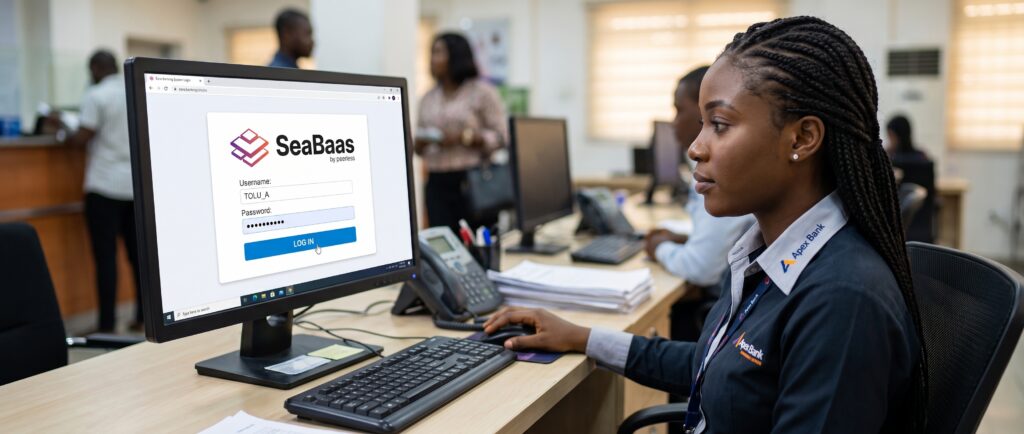

Have you ever wondered what happens in the split second between swiping your card and seeing the “approved” message? Or how a complex stock trade finalizes instantly across the globe? Behind every seamless digital payment, from an online purchase to a bank transfer, lies a powerful and often invisible technology. In short, we call this technology a Transaction Processing System (TPS). In this article, we’ll explore some key TPS System Examples that power our digital world.
A TPS is the silent backbone of modern finance, built to record, validate, and complete transactions with speed and precision. It ensures every payment or transfer happens securely and without delay, guaranteeing data availability, security, and integrity at every step. In today’s digital economy, this reliability isn’t optional. Modern TPS solutions are almost always real-time, handling each transaction immediately as it happens. This is known as Online Transaction Processing (OLTP), which makes point-of-sale purchases, e-commerce checkouts, and reservation systems possible.
For example, when you tap your card at a store or click “buy” on a website, the TPS takes over. It logs your request, verifies payment details, and completes the sale without delay. This ensures up-to-the-minute accuracy for both customers and businesses.
Real-World TPS System Examples in Finance
To illustrate, TPS technology powers countless everyday financial activities. Here are some key examples:
1. Retail and E-Commerce TPS Examples
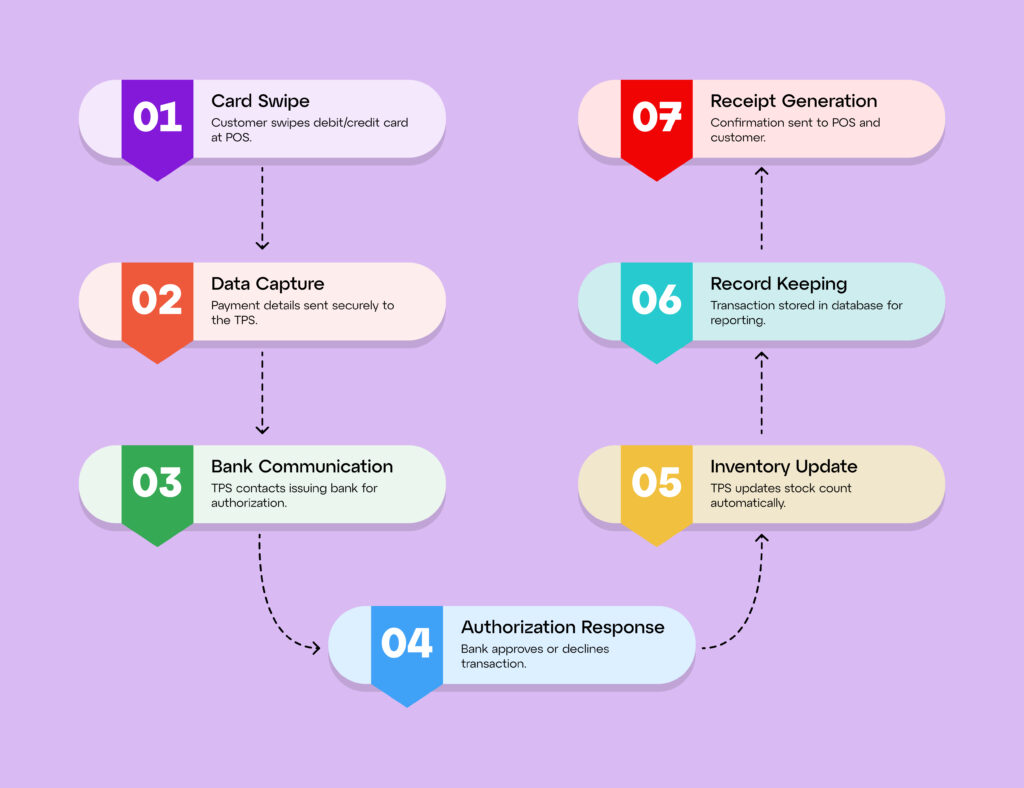
Point-of-sale (POS) systems and online shopping carts are classic TPS System Examples and use cases. When you swipe a credit card at a store, the TPS collects your payment data, communicates with your bank, and authorizes or declines the purchase in seconds. At the same time, it updates inventory and records the sale.
The same process applies to online shopping. For example every online checkout (on Amazon or other e-commerce sites) triggers a TPS that processes your order, verifies payment, updates stock levels, and arranges shipping. Behind the scenes, the TPS makes the transaction seamless and reliable.
How a TPS Transaction Works (Flowchart)
2. Banking and ATM Networks
Retail banks use a TPS every time you visit a branch or ATM. For instance, when a customer withdraws cash or checks their balance, the TPS validates their credentials, updates account balances, and dispenses the money. Even simple activities like a bank transfer or deposit are handled by the bank’s transaction engine in real time, ensuring account ledgers stay consistent.
3. TPS System Examples in Payment Networks and Card Processing
In addition, global payment networks like Visa and Mastercard use specialized TPS platforms. When you pay with a credit card, a TPS routes the transaction through the necessary clearinghouses and card schemes, authorizes the charge, and settles the payment across banks—all in less than a second. This high-speed process is what makes modern card networks so reliable.
4. Trading Platforms and Exchanges
Financial markets are a prime example of high-performance TPS System Examples in action. Stock exchanges and trading platforms run sophisticated transaction engines to match buy and sell orders. Each trade is a tiny transaction where the TPS matches buyers with sellers, updates stock prices, and settles the trade in real time. These systems are used by platforms like NASDAQ and the NYSE to process millions of orders per day, keeping the market moving instantly.
5. TPS System Examples in Real-Time Payment Systems
Beyond traditional banking, many specialized finance platforms use a TPS. This includes instant payment rails like Fednow in the U.S. and SEPA Instant in Europe, as well as digital wallets. In these systems, transactions between banks or wallets are processed immediately, end-to-end. Similarly, airline and hotel reservation systems, which are a form of TPS, check availability, process payments, and issue tickets in a single, seamless flow.
SeaBaas: A Next-Generation TPS for the Fintech Era
While TPS technology is everywhere, modern solutions are evolving to meet new demands. SeaBaas is at the forefront of this evolution, delivering a next-generation TPS built for the fintech era.
Unmatched Speed and Reliability
SeaBaas’s platform is designed for pure performance. With end-to-end transaction latencies in the 0.24 to 1 millisecond range, it processes requests from entry to confirmation in less than a thousandth of a second. This sub-millisecond speed is achieved through in-memory processing and a streamlined transaction path.
The platform also prioritizes uptime. Its distributed, fault-tolerant architecture runs across redundant cloud environments, allowing SeaBaas to maintain about 95-100% uptime in continuous operation. For mission-critical financial services, this level of availability is non-negotiable.
Modern Architecture and Integrations
Under the hood, SeaBaas uses a modern, service-oriented design. Instead of a legacy monolith, its engine treats each transaction as a stream of events through a pipeline of microservices. This allows components to scale independently and makes it easier for developers to integrate new features without overhauling the core system.
This modern architecture gives SeaBaas a clear advantage over older TPS solutions. It avoids the bottlenecks of traditional batch updates and can support very high transaction volumes by simply adding more parallel instances. It also includes enterprise-grade features like detailed audit logging, flexible business rules, and real-time analytics to support compliance and fraud detection.
Why SeaBaas Stands Out
In a crowded market, SeaBaas’s emphasis on real-time performance and cloud-native architecture sets it apart. While many legacy core banking systems were built decades ago, SeaBaas was built from the ground up for the “always-on” era. It uses modern development practices to ensure updates can be rolled out quickly without downtime, allowing it to keep pace with new payment schemes and emerging digital currencies.
Conclusion
The modern financial world runs on TPS technology. We’ve seen how a wide range of TPS System Examples—from retail POS systems to stock exchanges—all depend on a TPS to operate smoothly. From the instant approval of a credit card payment to the split-second matching of a stock trade, these systems are the unsung heroes of finance. We’ve seen how examples like retail POS systems, ATM networks, trading engines, and even airline booking services all depend on a TPS to operate smoothly. The common thread among all these use cases is the need for speed, accuracy, and reliability—requirements that modern TPS solutions must meet.
Ready to power your fintech with an ultra-fast, reliable TPS? Contact Peerless for a Demo Today to see how our real-time processing engine can accelerate your financial services.