

Core banking migration is one of the few technology projects that can quickly become a boardroom concern. For executives, the fear is straightforward. What happens if customers cannot access their accounts? If transfers fail? If branch teams cannot serve customers on Monday morning? And if reconciliation does not balance, reports look different, or support teams become overwhelmed? These are valid concerns.
A core banking system sits at the centre of deposits, loans, payments, customer records, accounting, reporting, access controls, and daily operations. Any migration plan that ignores business continuity exposes the institution to service disruption, reputational pressure, regulatory attention, and avoidable operational cost.
That is why business continuity management during core banking migration should begin long before the cutover weekend. It should shape the migration strategy, testing plan, fallback procedures, customer communication, performance monitoring, and post-go-live support model.
A successful migration does not depend on bravery during go-live. It depends on clear preparation, evidence-based decisions, and strong control over what happens before, during, and after the move.
Why Business Continuity Matters During Core Banking Migration
A bank can recover from many technology issues quietly. Core banking disruption is different because customers feel it almost immediately.
If a customer cannot receive a transfer, withdraw funds, view a balance, make a repayment, or access a channel, the issue becomes public quickly. Branch staff, contact centre teams, relationship managers, and digital support teams then face the pressure directly.
Executives should treat continuity planning as a business risk matter, not a technical attachment to the implementation plan. The migration team must understand which services must remain available, which services can tolerate a short pause, and which processes need a controlled workaround during the change.
Typical business continuity concerns include:
| Risk Area | What Can Go Wrong |
|---|---|
| Customer channels | Mobile, internet banking, USSD, cards, or agency channels fail after cutover. |
| Payments | Transfers, reversals, bill payments, and settlement processes face delays. |
| Branch operations | Tellers and branch teams cannot complete cash, cheque, or account activities. |
| Loan servicing | Repayments, schedules, arrears, or loan balances do not reflect correctly. |
| Finance and reconciliation | Account balances, GL positions, and reports require manual explanation. |
| Regulatory reporting | Reports or audit trails cannot be produced confidently after go-live. |
| Support operations | Customer complaints rise faster than support teams can respond. |
The right migration strategy should reduce these risks, not simply move the project toward a launch date.
Choosing the Right Migration Strategy
Two migration strategies usually come up in executive discussions: parallel run and big bang. Both can work. Both can fail when the institution chooses them for the wrong reasons.
The choice should depend on data quality, operational complexity, integration readiness, internal capacity, regulatory expectations, customer impact, and the institution’s tolerance for disruption.
Parallel Run
A parallel run allows the old core and the new core to operate together for a defined period. Teams compare outputs, validate balances, review transaction behaviour, and confirm that reports and workflows behave as expected before full adoption.
This approach gives leadership more evidence before the final switch. It can help finance, operations, compliance, risk, and technology teams build confidence in the new platform.
However, a parallel run requires serious governance. Staff may need to process, monitor, or validate activities across two environments. Reconciliation can become demanding. Teams must agree which system holds official records during each stage, how exceptions will be handled, and when the institution can safely move forward.
A parallel run is useful when:
| Situation | Why Parallel Run Helps |
|---|---|
| Data complexity is high | Teams can compare old and new outputs before full adoption. |
| Regulatory reporting is sensitive | Compliance and finance can validate reports in advance. |
| Product structures are complex | Teams can confirm that product rules behave correctly. |
| Integration risk is high | Channels, payments, and reporting feeds can be tested under closer watch. |
| Leadership wants stronger evidence | Executives can base the go-live decision on observed results. |
Parallel run can reduce migration anxiety, but it needs discipline. Without clear ownership, it can stretch timelines and create confusion.
Big Bang Migration
A big bang migration moves the institution from the old core to the new core within a defined cutover window. Once the cutover completes, the new platform becomes the system of record.
This approach can reduce the period of dual operation. It may suit institutions with cleaner data, fewer product variations, lower integration complexity, or strong internal readiness.
The risk is concentration. If the cutover fails, the institution may face intense service pressure in a short period. This makes preparation, rehearsal, fallback planning, communication, and performance monitoring very important.
A big bang migration may be suitable when:
| Situation | Why Big Bang May Work |
|---|---|
| The institution has a controlled scope | Fewer products, branches, and integrations reduce complexity. |
| Data has been cleaned and reconciled | Teams have fewer unresolved exceptions before cutover. |
| Testing has been thorough | User journeys, reports, and integrations have already passed validation. |
| Cutover time is limited | The business wants to avoid extended dual operations. |
| Fallback steps are clear | Leadership knows what happens if the cutover does not pass agreed checks. |
Big bang should never be treated as a shortcut. It works only when the institution has done the hard work before the cutover window begins.
How to Choose Between Parallel Run and Big Bang
Executives should avoid choosing a migration strategy based on what another bank did. The better question is: what level of operational risk can our institution manage, based on our current readiness?
Use these practical decision criteria.
| Decision Area | Question to Ask |
|---|---|
| Data readiness | Have customer, account, loan, ledger, and product records been cleaned and reconciled? |
| Integration readiness | Have channels, payment rails, CRM, risk tools, reporting systems, and third-party connections been tested? |
| Internal capacity | Can teams support a parallel run without creating operational fatigue? |
| Customer impact | Which services must remain available through the cutover period? |
| Regulatory sensitivity | Which reports, audit trails, and evidence must work immediately after go-live? |
| Fallback readiness | Can the institution return to a stable operating position if cutover checks fail? |
| Leadership confidence | Does the executive team have enough evidence to approve go-live? |
The strategy should match the institution’s real operating condition, not its preferred timeline.
Planning the Cutover Weekend
A cutover weekend is where many migration plans face their hardest test. By this point, the major work should already be done. The weekend should execute a controlled plan, not solve foundational problems.
A strong cutover plan should include:
- A confirmed cutover window
- A final data freeze plan
- A list of services affected during the window
- Step-by-step migration activities
- Named owners for each activity
- Go and no-go decision points
- Reconciliation checks
- Channel validation
- Integration validation
- Customer communication schedule
- Internal escalation contacts
- Fallback decision triggers
- Post-cutover monitoring plan
The cutover command centre should include technology, operations, finance, compliance, risk, customer support, branch operations, digital channels, and senior decision-makers. Each team should know its role before the weekend begins.
During the cutover, teams should track progress against a live runbook. This avoids confusion and helps leadership see whether the migration is on track.
A practical cutover sequence may look like this:
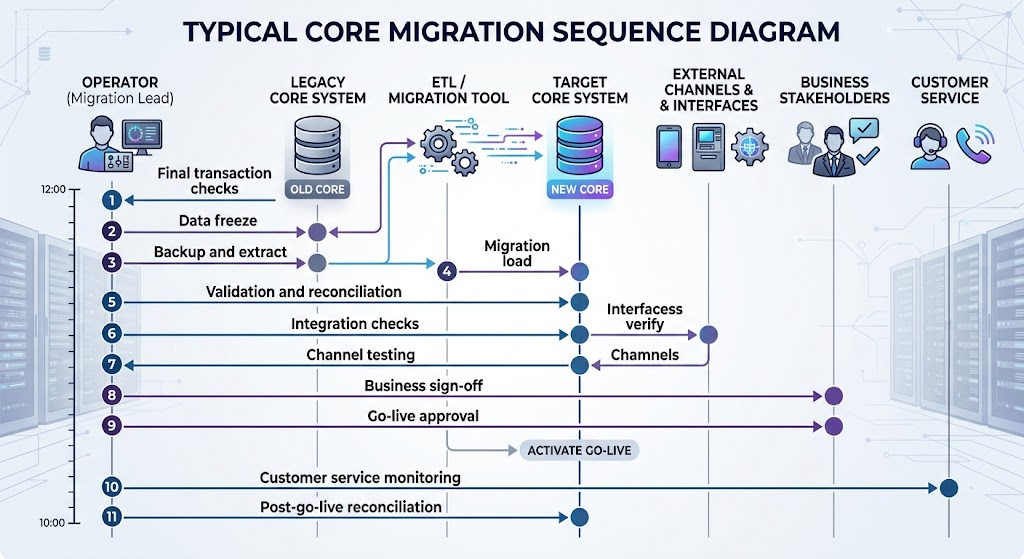
The exact sequence will differ by institution, but the principle remains the same. No activity should depend on memory or informal coordination.
Test Fallback Procedures Before Go-Live
Fallback planning is one of the most sensitive parts of core banking migration. It can be uncomfortable because it forces teams to discuss what happens if the migration does not proceed as planned.
That conversation is necessary.
Fallback procedures should answer practical questions:
| Fallback Question | Why It Matters |
|---|---|
| What failure conditions will trigger fallback? | Teams need objective criteria, not panic decisions. |
| Who can approve fallback? | Authority should be clear before the cutover begins. |
| How long can the business wait before deciding? | Delayed decisions can increase customer disruption. |
| Which systems must return first? | Critical services need priority. |
| What happens to transactions posted during the cutover window? | Teams need a clear treatment for in-flight activity. |
| How will customers and staff be informed? | Communication must remain controlled. |
| What evidence will be retained? | Audit, compliance, and lessons learned depend on proper records. |
Fallback procedures should be tested before go-live. A tabletop exercise is useful, but it is not enough for high-risk areas. Teams should rehearse realistic failure scenarios, including failed data load, channel failure, report mismatch, payment posting issue, or reconciliation exception.
The goal is not to expect failure. The goal is to remove uncertainty if a difficult decision becomes necessary.
Monitor Performance From the First Minute
Performance monitoring should begin before customers start using the new core at full volume.
Executives should insist on a clear monitoring dashboard for the early post-go-live period. This should cover technical performance and business outcomes.
Useful indicators include:
| Monitoring Area | What to Track |
|---|---|
| System availability | Whether the core and critical services remain accessible. |
| Transaction success rate | Successful versus failed transactions across channels. |
| Response time | How quickly the system responds to common actions. |
| Channel activity | Mobile, USSD, internet banking, branch, agency, and API usage. |
| Payment issues | Transfers, reversals, settlement, and posting exceptions. |
| Reconciliation exceptions | Differences between expected and actual balances or reports. |
| Support tickets | Complaint themes, volume, severity, and resolution time. |
| User issues | Staff login, access rights, workflow errors, and approval delays. |
| Regulatory reports | Ability to generate required reports from source data. |
Performance monitoring should continue through hypercare. The first few days after go-live often reveal issues that testing could not fully reproduce. That does not mean the migration has failed. It means the support model must respond quickly, track patterns, and fix root causes.
Customer Communication During Migration
Many institutions focus so much on the technical cutover that they under-plan communication. That creates avoidable pressure.
Customers do not need every technical detail. They need to know what may be affected, when it may happen, what they should do, and how to get help.
A practical communication plan should cover:
- Planned maintenance window
- Channels that may be temporarily unavailable
- Alternative options where available
- Expected service restoration time
- Customer support contact points
- Security warning against fraud attempts
- Post-migration reassurance
Communication should be honest and calm. Avoid overpromising. If there is a risk that some services may be unavailable for a defined period, say so clearly. If customers should complete urgent transactions before the window, tell them early.
Staff communication matters too. Branch teams, contact centre agents, relationship managers, and digital support teams should receive scripts, escalation paths, issue categories, and expected response timelines.
Customer trust depends on the experience before, during, and after migration.
Contingency Planning for Operational Teams
Business continuity during core banking migration also depends on what operational teams can do when systems are unavailable or partially available.
The institution should define controlled contingency procedures for:
| Area | Contingency Question |
|---|---|
| Branch operations | What can branches do if the core is unavailable for a short period? |
| Contact centre | How should agents respond to balance, transfer, or access complaints? |
| Digital channels | What message should users see if a service is temporarily unavailable? |
| Payment issues | Who owns failed transfer review and reversal handling? |
| High-value customers | How will relationship teams manage sensitive customers during the window? |
| Internal approvals | What happens to pending approvals during cutover? |
| Fraud and security | How will teams detect unusual activity during service changes? |
| Finance | How will finance validate balances and reports after cutover? |
These procedures should have limits. Manual workarounds can help continuity, but they also create control risk if poorly governed. Every workaround should have an owner, approval rule, record-keeping requirement, and end point.
How SeaBaas Supports Business Continuity Planning
SeaBaas is designed for financial institutions that need modern core banking infrastructure with scale, resilience, integration readiness, and operational control.
For migration planning, SeaBaas brings several useful advantages.
First, its microservices architecture supports flexibility, faster changes, and component-based scaling. This matters during and after migration because institutions need a core that can adapt without turning every change into a heavy rework exercise.
Second, SeaBaas supports RESTful APIs and webhook events, which help institutions connect fintech partners, channels, and ecosystem services more cleanly. It also provides real-time core-to-channel data, live dashboards, regulatory reports, and streamlined data reconciliation across channels.
Third, the SeaBaas functional blueprint includes a Smart Adapter Integration Gateway with open APIs and compatibility patterns that include REST, ISO 20022, ISO 8583, and SOAP. For a migration programme, this helps teams think more clearly about how customer channels, payments, reporting systems, and third-party services will connect to the new core.
SeaBaas also includes core modules that support operational control, including configuration engine, customer management, customer 360, product factory, credit management, audit trail, EOD processing, branch transactions, account restriction, chart of accounts, charges, taxes, currency management, fiscal period configuration, and user access control.
From a continuity perspective, these capabilities matter because migration does not end at go-live. The institution needs daily operations to continue, reports to remain explainable, access rights to work properly, branches to operate, and exceptions to be traceable.
Peerless proof materials cite 99.95% SeaBaas uptime and strong production performance metrics. They also reference SeaBaas deployment across commercial and microfinance banking customers. These proof points should support executive confidence during vendor evaluation, while the institution still validates its own migration scope, risk profile, and contractual SLA terms.
SeaBaas Lite for Leaner Institutions
For microfinance banks, cooperatives, digital lenders, fintech platforms, and growing financial institutions, SeaBaas Lite offers a streamlined SaaS route.
SeaBaas Lite is built for institutions that need core banking capabilities without the cost, complexity, or timeline of a full enterprise deployment. Its implementation journey includes environment setup, product configuration, user training, data migration, parallel run where required, live monitoring, and hypercare support.
This is important for smaller institutions because business continuity risk does not disappear with size. In many cases, MFBs and growing institutions have leaner teams, fewer technical resources, and limited room for extended disruption.
SeaBaas Lite also includes support structures such as a dedicated Customer Success Manager, technical support desk, product update communication, and structured escalation and SLA framework. These are useful during migration because support clarity can reduce confusion when issues arise.
A Practical Executive Checklist
Before approving a core migration go-live, executives should ask these questions:
| Area | Executive Question |
|---|---|
| Strategy | Have we chosen parallel run or big bang based on evidence? |
| Data | Have customer, account, loan, ledger, and report outputs been reconciled? |
| Integrations | Have customer channels, payments, CRM, risk, and reporting systems passed testing? |
| Cutover | Is there a detailed runbook with named owners and decision points? |
| Fallback | Have we tested fallback procedures and agreed approval authority? |
| Monitoring | Do we have real-time visibility into system and business performance? |
| Customer communication | Have customers received clear notice where service may be affected? |
| Staff readiness | Do branches, contact centre, and relationship teams know what to say and do? |
| Hypercare | Are support, escalation, and issue tracking structures ready? |
| Leadership sign-off | Does the executive team have enough evidence to approve go-live? |
A migration should not move forward because the calendar says so. It should move forward because the institution has enough evidence that continuity risk is understood and controlled.
Conclusion
Business continuity management during core banking migration protects the institution from avoidable disruption.
Executives should pay close attention to the migration strategy, cutover plan, fallback procedures, performance monitoring, customer communication, and operational contingency arrangements. These areas determine how confidently the institution can move from legacy infrastructure to a modern core.
Parallel run offers more evidence before full adoption. Big bang can work for a controlled scope with strong readiness. Both approaches require data discipline, integration testing, business sign-off, and clear leadership decisions.
For institutions evaluating SeaBaas or SeaBaas Lite, the practical value sits in the combination of modern architecture, API-first integration, operational modules, reporting support, local implementation guidance, and structured post-go-live support. These strengths help banks and growing financial institutions reduce migration uncertainty and prepare for continuity from the start.
Request a Core Banking Business Continuity Readiness Checklist
Before you migrate, understand the operational risks that could affect customers, channels, payments, reporting, branches, and support teams.
Request the checklist and use it to assess your migration strategy, cutover plan, fallback procedures, performance monitoring, customer communication, and hypercare readiness.