
What Is SeaBaas?
When financial institutions search for “what is SeaBaas?” or “what is a modern core banking system?”, they are usually trying to answer a deeper question: what does next-generation banking infrastructure actually look like in practice?
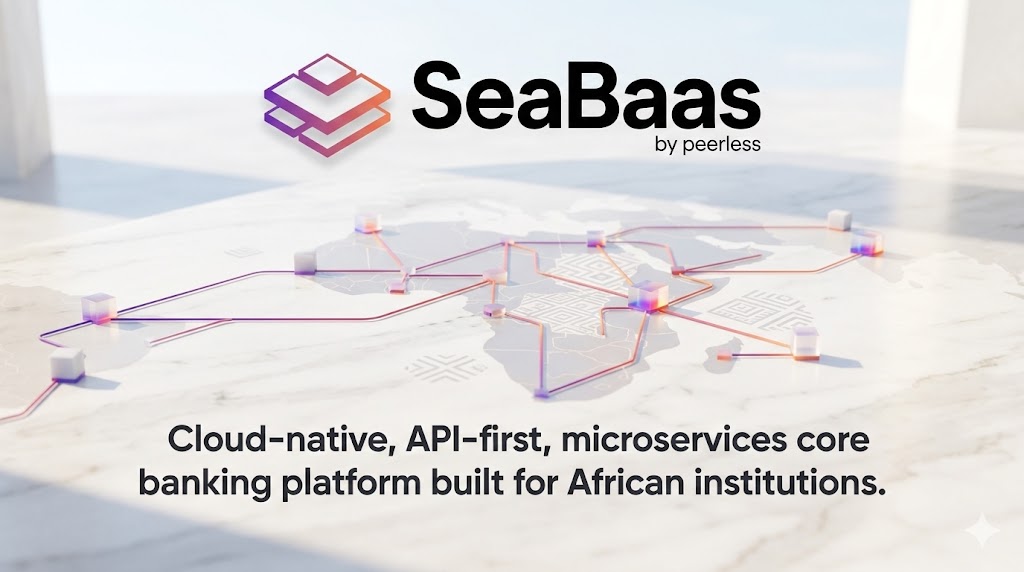
The SeaBaas core banking system is a cloud-native, API-first, microservices core banking platform built in Africa and deployed for African realities. SeaBaas replaces rigid legacy cores with a modern architecture. This design supports real-time processing, seamless integrations, and rapid product innovation
At its foundation, SeaBaas is built on microservices. This means each banking function such as deposits, loans, payments, reporting, and compliance operates independently but communicates through secure APIs. The result is a flexible system that can evolve without destabilizing operations. For institutions seeking cloud-native core banking in Africa, this architecture ensures elasticity, resilience, and lower long-term infrastructure costs.
SeaBaas powers commercial banks, microfinance banks, and fintech institutions across Nigeria and beyond. Peerless offers the standard SeaBaas Enterprise for large-scale operations and SeaBaas Lite. For growing financial institutions, SeaBaas Lite provides a streamlined SaaS variant. It retains the same API-first foundation while delivering faster deployment, simplified configuration, and a lower total cost of ownership. This makes it an attractive option for microfinance banks and emerging fintechs searching for the best core banking software in Nigeria without the complexity of enterprise-level infrastructure.
The true test of any core banking software in Nigeria is its performance under heavy transaction loads. The SeaBaas core banking system is built for resilience. In two years of operations, it has processed over 4 billion transactions, maintains 99.95% system availability, and has enabled partner institutions to achieve up to a 60% reduction in transaction processing time. This combination of speed and reliability establishes SeaBaas as a leading cloud-native core banking Africa solution.
Who Is SeaBaas Core Banking Built For?
The SeaBaas core banking system empowers institutions to modernize their infrastructure without compromising resilience, compliance, or scale. Whether the search is for core banking software for microfinance banks, a core banking solution for fintech startups, or a core banking platform for Tier 1&2 banks, SeaBaas was built to serve multiple tiers of the financial ecosystem with precision.
Commercial Banks (Tier 1 & Tier 2 Institutions)
For established commercial banks, SeaBaas supports full enterprise deployment. Institutions can choose between dedicated cloud environments or on-premise installations, depending on regulatory, data residency, and infrastructure preferences. The platform is engineered for high-volume transaction processing and continuous availability.
Its microservices core banking platform architecture allows large banks to innovate without risking system-wide disruption. Product launches, regulatory updates, and integrations can happen without lengthy code rewrites. For Tier 2 banks under pressure to compete with agile fintechs, SeaBaas provides a modern core banking system for banks that need both performance and speed.
Microfinance Banks & Growing Institutions (SeaBaas Lite)
For institutions searching for SaaS core banking in Nigeria, SeaBaas Lite offers a streamlined alternative. It is delivered as a lean, fully integrated SaaS solution with simplified deployment and predictable pricing. Built-in compliance templates align with Nigerian regulatory requirements, reducing operational friction.
Unlike enterprise configurations, SeaBaas Lite is not modular. It is intentionally integrated to simplify onboarding and reduce complexity. This makes it ideal for microfinance banks and emerging institutions looking for the best core banking software in Nigeria with faster time to value.
Fintechs & Digital-Only Institutions
Fintech startups require infrastructure that integrates effortlessly into digital ecosystems. SeaBaas offers API-ready architecture, Open Banking compatibility, and sandbox environments that allow developers to test and deploy new services rapidly.
For digital-first institutions, SeaBaas is not just infrastructure. It becomes the engine that powers embedded finance, partnerships, and scalable growth across Africa’s evolving financial landscape.
Why Banks Are Replacing Legacy Core Banking Systems
Across Africa and emerging markets, banks are actively rethinking their technology foundations. Searches around problems with legacy core banking, why banks are modernizing core systems, and core banking digital transformation challenges reflect a growing realization: traditional systems are no longer aligned with how banking operates today.
The first challenge is monolithic rigidity. Legacy core systems operate as single, tightly coupled platforms. This interconnected design makes even minor updates risky. Launching a new product, adjusting pricing logic, or implementing a regulatory change often requires extensive testing and long deployment cycles. This slows innovation and creates internal bottlenecks.
Integration is another major limitation. Modern banking depends on APIs, fintech partnerships, mobile channels, and real-time data exchange. Older systems were not designed with open architecture in mind. As a result, integrations become complex, expensive, and fragile. This limits a bank’s ability to participate in ecosystem-driven growth.
Cost of ownership continues to rise. Licensing fees, vendor dependencies, hardware upgrades, and customization projects accumulate over time. What initially seemed stable becomes financially restrictive, especially when upgrades require foreign currency payments or extended vendor engagements.
These older platforms create costly reporting inefficiencies. Extracting accurate data for internal audits or Central Bank compliance often involves running heavy batch processes overnight. Modern banking demands real-time data access to make fast business decisions and meet strict regulatory mandates.
Scalability is equally problematic. As transaction volumes increase, legacy cores often struggle to maintain performance without costly infrastructure expansion.
These pressures are why many institutions are moving toward cloud-native, API-first platforms like the SeaBaas core banking system. Modern infrastructure enables banks to replace rigidity with adaptability, and replace technical debt with long-term operational strength.
How SeaBaas Core Banking Architecture Works
Understanding modern infrastructure requires having the core banking system architecture explained clearly. The SeaBaas core banking system operates as a cloud-native platform. It combines microservices, API-first integration, and real-time processing into a single framework that delivers speed and continuous uptime.
Microservices-Based Core
At its foundation, SeaBaas operates on independent service processors. Each banking function, such as deposits, loans, payments, or reporting, runs as a separate microservice. The platform containerizes these services and uses orchestration tools to automate scaling and maintain stability.
This architecture enables fault isolation. If one service encounters an issue, it does not bring down the entire system. The rest of the platform continues running, preserving uptime and customer trust. This structure defines what a modern microservices core banking platform should deliver: resilience without rigidity.
API-First & Open Banking Ready
SeaBaas is designed as an API-first core banking system. REST APIs, ISO 20022, and ISO 8583 standards are built into the architecture, not layered on later. The Smart Adapter Integration Gateway allows seamless connectivity with payment switches, credit bureaus, identity verification systems, and fintech applications. Webhooks also support real-time event-driven communication, enabling institutions to participate fully in Open Banking ecosystems.
Configuration Engine (Not Code Rewrites)
Unlike legacy systems that require code changes for product updates, system updates in SeaBaas happen through a native Configuration Engine. The Product Factory allows banking teams to create new account types and loan structures purely through interface configuration. A centralized Pricing and Limits Engine manages fee structures using workflow-driven rules. This setup shifts product creation from software developers directly to business managers.
Real-Time Core-to-Channel Data
Legacy systems often rely on overnight batch processing to reconcile accounts. SeaBaas operates on a unified ledger that provides instant transaction visibility across all touchpoints. When a customer transfers funds on a mobile app, the balance updates immediately across branch terminals and USSD interfaces. Live dashboards also give banking executives accurate data for compliance reporting and operational decision-making.
Core Functional Modules of SeaBaas
A comprehensive core banking modules list defines the operational capability of a financial institution. The SeaBaas core banking system provides a comprehensive suite of functional modules designed to operate seamlessly within a unified, cloud-native environment and to structure complex financial products.
Deposits & CASA
SeaBaas supports the complete lifecycle of savings, current, and term deposit accounts. Institutions can configure interest rules, minimum balances, tiered pricing, and account limits directly within the system. The flexibility allows banks and microfinance institutions to tailor deposit products to specific customer segments without complex custom development.
Credit Management
The platform delivers end-to-end loan lifecycle management. From origination and credit assessment to disbursement, restructuring, and write-offs, SeaBaas handles the operational and accounting processes within one integrated framework. This ensures real-time visibility of loan performance and improves risk monitoring across portfolios.
Payments & Settlement
SeaBaas integrates seamlessly with Nigeria Inter-Bank Settlement System (NIP) infrastructure, supports cross-border remittance processing, and manages cheque clearing workflows. The architecture enables real-time settlement and high transaction throughput, supporting both retail and enterprise payment volumes.
General Ledger & Accounting
The system includes a configurable Chart of Accounts, fiscal period management, and multi-currency support. Transactions automatically post to the unified ledger, ensuring consistency and audit readiness across departments.
Regulatory Reporting & Compliance
For institutions focused on core banking compliance features, SeaBaas offers CBN-aligned reporting templates, automated regulatory reporting capabilities, and built-in audit trails. These tools reduce manual intervention and support faster submission of required returns, strengthening compliance posture across the organization.
SeaBaas Lite – SaaS Core Banking for Growing Financial Institutions
For institutions searching for affordable core banking software in Nigeria or evaluating SaaS core banking for microfinance, the priority is clear: modern infrastructure without enterprise-level complexity or cost. SeaBaas Lite was designed to meet that need.
SeaBaas Lite is the streamlined SaaS variant of the SeaBaas core banking system, purpose-built for microfinance banks, emerging financial institutions, and fintech startups. It delivers the same cloud-native, API-first foundation as the enterprise version, but packaged for faster onboarding and predictable pricing. For institutions exploring SeaBaas pricing for microfinance or seeking the best core banking for MFB Nigeria, this model provides clarity and cost efficiency.
What Makes SeaBaas Lite Different?
Unlike the enterprise version, SeaBaas Lite operates as a fully integrated, non-modular system. This specific design choice accelerates implementation for smaller operational teams. It retains the robust API-first foundation of the main platform. This makes it an ideal core banking for fintechs in Nigeria, enabling rapid connections to third-party payment gateways and identity verification services.
The system comes pre-configured with built-in compliance templates to handle local regulatory requirements natively. Institutions also gain a distinct local support advantage. Technical issues are resolved within the same time zone by engineers who understand the regional financial landscape. This specialized focus establishes it as a highly effective SaaS core banking for microfinance operations.
Why It Works For Microfinance Banks
For microfinance banks and fintechs in Nigeria, SeaBaas Lite lowers total cost of ownership through SaaS delivery and reduced infrastructure overhead. Deployment timelines are shorter, allowing institutions to begin operations quickly. SeaBaas incorporates Nigerian reporting and compliance structures directly into its core. This creates a practical and scalable banking solution for growing institutions.
Business Benefits of SeaBaas
The true measure of any infrastructure upgrade is its impact on the bottom line. The benefits of modern core banking extend beyond IT efficiency; they dictate market competitiveness. SeaBaas delivers measurable commercial advantages to financial institutions operating in emerging markets.
Reduce Total Cost of Ownership
SeaBaas delivers over 80 percent functional parity with major global core vendors at a significantly lower cost structure. By eliminating heavy customization cycles and reducing dependency on foreign currency–denominated vendor contracts, institutions lower their long-term financial exposure. Reduced FX pressure and simplified infrastructure requirements contribute directly to improved cost predictability. For banks seeking scalable core banking software in Africa, controlling total cost of ownership becomes a strategic advantage rather than a recurring burden.
Launch Products Faster
Market share goes to the fastest innovator. SeaBaas relies on configuration-driven product rollouts rather than hardcoding. Instead of waiting months for a vendor to build a custom feature, banking teams use modular composition to design and launch new credit or savings products in days.
Scale Without Replatforming
Growth should not trigger expensive system replacement. As a highly scalable core banking software Africa solution, SeaBaas features elastic scalability. The architecture expands automatically to handle peak transaction volumes and contracts when demand drops. This infrastructure allows institutions to serve millions of users without downtime, eliminating the need to replatform as the customer base grows.
Improve Customer Experience
Real-time processing ensures customers see immediate transaction confirmations and accurate balances. Omni-channel readiness allows seamless integration across mobile apps, USSD, internet banking, and branch systems. This consistency strengthens trust and supports digital-first engagement across customer segments.
Performance Proof: SeaBaas In A Real Environment
When institutions evaluate a new core, they do not rely on architecture diagrams alone. They look for performance evidence. They ask questions like, “does the system deliver under real-world pressure?”
In its first year of scaled operations across partner institutions, the SeaBaas core banking system processed over 2 billion transactions. This volume was not concentrated in isolated pilots. It represented live banking environments serving active customers daily.
The platform supported more than 5 million end users, spanning commercial banks and microfinance institutions. These users transacted across multiple channels, including digital banking platforms, branch networks, and integrated fintech services.
Operational efficiency also improved measurably. Institutions experienced up to 60 percent faster transaction processing, reducing queue times, reconciliation delays, and operational bottlenecks. This performance gain translated into tangible cost reductions, contributing to over $1 million in operational savings within the first year of deployment.
System availability remained consistent throughout this period, with 99.95 percent uptime recorded across environments. For financial institutions, uptime is not a technical metric. It is a trust metric. Customers expect continuous access to their funds, and regulators expect resilient infrastructure.
These results demonstrate that SeaBaas is not positioned as a theoretical modern platform. It has operated at scale, sustained high transaction volumes, and delivered measurable business impact.
SeaBaas vs Global Core Banking Providers
Financial institutions often evaluate the trade-offs between localized platforms and heavy international systems.
SeaBaas vs Temenos
Global providers charge licensing and maintenance fees in foreign currencies. This creates unpredictable operational costs tied to exchange rate fluctuations. As viable alternatives to Temenos Africa gain traction, banks prioritize systems built for their specific economic realities. Discussions comparing SeaBaas vs Temenos frequently center on this exact point. Foreign systems carry heavy capital expenditure and complex integration timelines. An Africa-built platform like SeaBaas provides predictable local pricing alongside immediate regional relevance.
SeaBaas vs Mambu
When technology teams evaluate SeaBaas vs Mambu, they find two cloud-native architectures. SeaBaas distinguishes itself by addressing the specific infrastructural challenges of emerging markets natively. It connects directly with local payment switches like NIBSS and handles regional agency banking frameworks without custom middleware.
Global platforms treat African regulatory requirements as secondary features requiring expensive custom development. SeaBaas provides deep local compliance alignment from day one. It supports Central Bank directives and regional reporting mandates natively. This architecture enables faster regulatory adaptation. When new compliance rules emerge, banking teams update the system through the configuration engine. Banks avoid waiting months for a foreign vendor to release a global software patch. This localized focus keeps financial institutions agile and fully compliant.
See full comparison of corebanking platforms with SeaBaas here.
Security, Governance & Regulatory Alignment on SeaBaas
For banks, architecture must support more than speed and scalability. Your core platform must protect the institution while satisfying regulatory expectations. The SeaBaas core banking system embeds governance and compliance controls directly into its operational framework.
Security begins with strict role-based access controls, ensuring that users only interact with functions and data appropriate to their responsibilities. This reduces internal risk and supports segregation of duties across departments.
Every transaction and configuration change is logged through comprehensive audit trails. These records provide traceability required for internal reviews, regulatory inspections, and external audits. Rather than assembling evidence manually, compliance teams can access system-level documentation in real time.
SeaBaas aligns natively with regulatory requirements. The platform builds GAP compliance standards into its workflows and matches its reporting logic to local regulations. Built-in reporting modules enable institutions to generate required regulatory returns efficiently, reducing dependency on manual reconciliation.
This combination of security, governance, and compliance functionality positions SeaBaas as a secure core banking platform built for African regulatory realities. It strengthens operational control while maintaining the flexibility expected from a modern, cloud-native banking system.
SeaBaas Deployment Options & Commercial Model
SeaBaas is designed to accommodate different institutional needs through flexible deployment and commercial models.
Deployment Models
The core banking implementation timeline depends directly on the chosen hosting environment. SeaBaas provides three distinct deployment paths to match specific institutional scale and regulatory demands.
The multi-tenant SaaS model powers SeaBaas Lite. This setup lowers the core banking SaaS cost by securely sharing cloud infrastructure. It allows microfinance banks and fast-growing fintechs to launch operations in weeks.
The dedicated cloud option gives mid-tier and commercial banks an isolated environment. It offers high scalability and complete control over system resources. This model supports enterprise-grade performance while leveraging the elasticity of cloud-native infrastructure.
For institutions operating under strict internal data residency policies, SeaBaas offers an on-premise deployment. The platform installs directly onto local servers while maintaining its modern microservices design.
Deployment models and complexity determine implementation timelines, but the architecture shortens onboarding cycles compared to legacy core replacements.
Commercial Model Overview
The SeaBaas commercial model is license-based. It removes unpredictable foreign exchange risks by offering transparent, localized pricing structures tied to institutional size and active modules. Predictable pricing allows banks to plan for long-term growth.
Every deployment is backed by a strict Support SLA. This agreement guarantees rapid response times and continuous monitoring from regional engineering teams. The platform also connects to a broad partner ecosystem. Banks work with certified system integrators and technology partners to ensure smooth data migration and continuous operational improvement.
How SeaBaas Supports Africa’s Digital Transformation
Africa’s financial sector is evolving rapidly. Digital payments are expanding, mobile banking adoption is increasing, and regulators are raising standards for resilience and inclusion. In this environment, infrastructure matters. A modern banking ecosystem cannot run on outdated foundations.
SeaBaas was built in Africa, for Africa. It reflects the operational realities, regulatory structures, and growth ambitions of financial institutions across the continent. Rather than adapting foreign systems to local conditions, SeaBaas is designed with those conditions at its core.
With offices in Lagos and Dubai, Peerless supports institutions operating across West Africa, East Africa, and the MENA region. This regional presence strengthens responsiveness to regulatory changes and provides closer technical support. It also aligns with broader ambitions for pan-African financial integration, where interoperability and cross-border capability are becoming increasingly important.
SeaBaas functions as infrastructure, not just software. It provides the digital backbone that enables banks, microfinance institutions, and fintechs to expand access, improve operational efficiency, and introduce innovative financial products. By combining cloud-native architecture with regulatory alignment, it supports institutions seeking sustainable digital transformation rather than incremental modernization.
As African banking systems scale and diversify, infrastructure choices will shape competitiveness. SeaBaas positions itself as a foundational platform that supports long-term growth, resilience, and regional expansion across the continent’s evolving financial landscape.
Frequently Asked Questions About SeaBaas
What makes SeaBaas core banking different from Temenos or Mambu?
The primary difference lies in positioning and design philosophy. The SeaBaas core banking system is built in Africa for African regulatory and operational realities. While global platforms like Temenos or Mambu serve multiple markets, SeaBaas embeds local compliance logic and reporting structures natively. It combines microservices architecture, cloud-native scalability, and predictable commercial models without heavy foreign currency exposure. This makes it a strong alternative in any core banking comparison across Africa.
Is SeaBaas compliant with CBN regulations?
SeaBaas is designed to align with Central Bank of Nigeria regulatory requirements. It includes built-in reporting templates, audit trails, role-based access controls, and compliance-ready workflows that support CBN reporting standards. Institutions deploying SeaBaas remain responsible for their regulatory approvals, but the system architecture is built to support CBN-aligned operations.
Can SeaBaas core banking integrate with fintech apps?
Yes. SeaBaas is an API-first core banking system that supports REST APIs, ISO messaging standards, and webhook-based integrations. It connects seamlessly to fintech platforms, payment gateways, credit bureaus, and identity verification services, enabling ecosystem participation and Open Banking readiness.
Is SeaBaas core banking suitable for microfinance banks?
Yes. SeaBaas Lite, the SaaS variant of the SeaBaas core banking system, is specifically designed for microfinance banks and growing financial institutions. It offers simplified deployment, built-in compliance templates, and predictable pricing.
Can I migrate from my existing legacy core to SeaBaas?
Migration is supported through structured data mapping, phased transition strategies, and parallel run environments where necessary. Implementation teams work with institutions to minimize disruption during core replacement.
How long does SeaBaas core banking implementation take?
Deployment timelines depend on the chosen model and institutional complexity. SeaBaas Lite can be configured and deployed in weeks for smaller institutions. Enterprise deployments for commercial banks with complex data migrations follow a structured project plan that extends over a few months.
What is the cost of SeaBaas?
SeaBaas uses a transparent, license-based commercial model. Pricing scales predictably based on the institution’s size, the selected deployment model (multi-tenant SaaS, dedicated cloud, or on-premise), and the specific functional modules activated. This structure removes the unpredictability of foreign exchange fluctuations. See SeaBaas Lite pricing here or contact our sales team for SeaBaas enterprise pricing.
Ready to Modernize Your Core Banking Infrastructure?
The financial sector rewards agility. Institutions running on legacy systems face mounting costs and slow product rollouts. Transitioning to the SeaBaas core banking system removes these operational roadblocks. It provides the digital infrastructure to scale efficiently and meet regulatory demands without friction. Upgrading to a modern core banking system ensures long-term market competitiveness and uninterrupted service delivery.
If you are evaluating core banking software in Nigeria, comparing alternatives to global vendors, or exploring how to reduce total cost of ownership without sacrificing performance, this is the right time to assess your infrastructure.
Book a Clarity Session to review your current core banking environment, understand your modernization options, and see a live demonstration of how SeaBaas can support your institution’s next phase of growth.